Why most of our tools are steel
We keep coming back to stainless steel because it answers the first question we ask: what does this tool feel like in your hand? It has a cool, solid weight that tells you it's there without being heavy enough to tire your arm. That balance matters more than a spec sheet can say. Our name, Bellemain, means beautiful hands in French, and we start from the hand every time. A potato ricer or a colander should feel natural the first time you pick it up, and steel is the material that lets us shape handles and contours with that single goal in mind.
Steel also stays out of the way of your food. It doesn't hold onto the smell of garlic or onion. It won't react with lemon juice or tomato. It won't chip, crack, or peel into your work. And while we do make tools from bamboo, carbon steel, and aluminum where those materials do the job better, steel is the one we reach for when we want a tool that will do the same thing ten years from now as it did the day you unpacked it.
A number stamped into the metal is the one fact a photograph cannot show. Most of our steel pieces carry an 18/8 or 18/10 grade mark, which tells you something about the alloy but nothing about how to care for it. The rest of this article is about what that number means, what it doesn't protect against, how to wash steel so it stays bright, and where the other materials in our range earn their place.
18/8 and 18/10: what the numbers mean
Steel is mostly iron, with a little carbon in it. What makes it stainless is chromium. The numbers 18/8 and 18/10 tell you how much chromium and nickel sit in the alloy. 18/8 means 18 percent chromium and 8 percent nickel. 18/10 means 18 percent chromium and 10 percent nickel. Chromium is the part that forms a clear, protective skin on the surface. Nickel adds more resistance to dulling and a little more shine.
On 14 of our 41 stainless pieces, the grade is right on the metal. We put it there because the two alloys are easy to confuse and the difference is small in daily use. A fork in 18/10 can stay a touch brighter over years. A colander in 18/8 or 18/10 will still rinse clean and shrug off rust in a normal kitchen. Both grades are food safe, and neither adds a flavor to what you cook or eat.
| Piece | Grade named | Dishwasher safe | Price |
|---|---|---|---|
| Stainless Steel Colander for Kitchen, 3 & 5 Qt Strainers | 18/8 | Yes, stated | $47.99 |
| Stainless Steel Potato Ricer Mashed Potato Masher - Black | 18/10 | Yes, stated | $21.99 |
| Stainless Steel Measuring Cups Set of 6, Nesting Design (BM-XFKYY) | 18/8 | Yes, stated | $20.99 |
| Metal Lemon Squeezer, Stainless Steel Citrus Juicer, Black | 18/10 | Not stated | $25.99 |
| Stainless Steel Colander Set of 2, 3 and 5 Qt | 18/8 | Yes, stated | $66.22 |
| 15 oz Large Potato Ricer | 18/10 | Not stated | $24.99 |
| Metal Lemon Squeezer, Stainless Steel Citrus Juicer, Pink | 18/10 | Not stated | $25.99 |
| French Press Coffee Maker Extra Filters Included, 35 oz | 18/10 | Yes, stated | $29.99 |
What the numbers do not do is make a piece stronger or harder. They also will not make it nonstick. A knife in 18/10 is not sharper, and a bowl in 18/10 is not thicker. The grade does not protect steel from salt left to sit on a wet surface, and it will not stop a harsh scouring pad from leaving marks. If you want the bright finish to last, the number is only the starting point. How you wash it and where you set it down do the rest.
Water spots, pitting and the salt you forgot
It goes against instinct to tell a customer what can go wrong with a tool we make. But stainless steel does not mean stain-proof, and the sooner you know that the less likely you are to blame the pan.
Water spots are the harmless one. They are just minerals left behind when a droplet dries. A towel fixes them. What looks worse is pitting, tiny gray craters that do not scrub out. Pitting starts when salt sits on wet steel. You salt a pot of cold water, the crystals drop to the bottom, and before the water boils they have already started eating into the surface. We have seen it on a brand-new colander left in a sink with salty pasta water overnight. The steel was fine. The salt was not.
The fix is small. Bring water to a boil first, then add salt. Rinse a colander right after you drain it. Dry a mixing bowl instead of letting it air-dry in the rack. None of this makes the tool fragile. It just means the steel asks for one thing you were probably going to do anyway.
The dishwasher question, piece by piece
Not every piece of stainless steel in our range carries the same care instructions, because a tool is more than the metal it is cut from. 15 of the stainless steel tools we make are marked dishwasher safe right on the piece. The number is not a guess. We test the whole assembly, metal, handle, any seal or spring, through a week of ordinary home cycles, and we publish the claim only when nothing loosens, pits or warps. That mark is a promise, not a sales line.
The dividing line is rarely the steel itself. A colander, a mixing bowl, a funnel: these are shells of metal with no moving parts, and they come out clean. A tool with a hinge, a spring or a long plastic handle changes the rule. Our citrus squeezer and potato ricer have pivot points where water trapped overnight can dull the action long before rust appears.
| Department | Pieces | Dishwasher safe, stated | Hand wash, stated or implied | From |
|---|---|---|---|---|
| Coffee & Tea | 6 | 1 | 5 | $17.99 |
| Baking | 8 | 2 | 6 | $11.99 |
| Cutlery & Knife Storage | 4 | 3 | 1 | $27.99 |
| Drawer & Cabinet Organization | 3 | 0 | 3 | $9.89 |
| Dish Drying | 12 | 2 | 10 | $11.99 |
| Grill & Burger Presses | 7 | 0 | 7 | $12.99 |
| Hand Tools | 22 | 2 | 20 | $3.00 |
| Colanders & Mixing Bowls | 7 | 5 | 2 | $23.99 |
The moka pot’s plastic handle and silicone gasket will harden after many cycles, so we keep it off the dishwasher list. The French press plunger, even in stainless, has a fine mesh that holds detergent residue if the spray does not reach it squarely. These are not flaws. They are consequences of putting a mechanism through a machine that was designed for plates and glasses.
The table below shows the status of every tool in the range. If you prefer the dishwasher, pick from the column that says yes. The ones that say no are not weaker or less durable. They simply last longer when you wash them by hand with hot water and a cloth, which is the subject of the next section. We will talk about what hot water actually does to steel, and why the board you set the pot on matters nearly as much as the soap.
Hot water, soap and the board it sits on
We wash most of our stainless by hand at the sink. Hot tap water and a standard dish soap do the real work. A soft sponge gets into the seams around a handle or a lid. We reach for a heavy scrubber only when something has baked on, and we keep it away from polished bowls. A coarse pad can dull a bright finish, and that is not a flaw in the steel. It is the wrong tool for the job.
We do not soak a colander or a mixing bowl overnight. A short soak loosens stuck food, but a long one just leaves cold, greasy water behind. Rinse each piece well in hot water, then wipe it dry with a clean cloth. If you let water sit on the surface, it will leave a mark. The steel is not the problem. The water is. This is a two-minute routine, and it suits a cook who would rather wash as they go than face a full sink later.
To keep all cutting boards clean, the Hotline recommends washing them with hot, soapy water after each use; then rinse with clear water and air dry or pat dry with clean paper towels.
USDA Food Safety and Inspection Service, Cutting Boards. Read 23 August 2026. Source
Wash for at least 20 seconds with soap and warm or cold water.
Centers for Disease Control and Prevention, Preventing Food Poisoning. Read 23 August 2026. Source
The board it sits on matters as much as the sink. We set a hot pan or a just-rinsed bowl on a wooden board or a folded towel, not on a cold stone counter. A dry mat works too. We dry a wooden or bamboo board before we put it away, because trapped water is harder on the board than on the steel. Our tools are made to nest, but we never nest them wet. For plain steel, hot water, soap and a dry board are enough.
Bamboo: the other material in the drawer
We reach for stainless steel when a tool has to hold an edge, take heat, or spend time underwater. But not everything in the kitchen works hard in those ways. Some pieces just need to keep things quiet, organized, and easy to reach. For those jobs we use bamboo.
Bamboo gives us a material that is lighter and softer than steel. It will not chip a knife tip the way a metal block can. It does not clatter when you pull open a drawer. We make 2 pieces from it, mostly drawer organizers and knife blocks. A bamboo knife block holds a set of serrated steak knives upright without dulling their teeth.
Bamboo absorbs very little moisture and resists scarring from knives, so they are more resistant to bacteria than other woods.
USDA Food Safety and Inspection Service, Cutting Boards. Read 23 August 2026. Source
The organizers slide into standard drawers and sort the tools that otherwise end up in a jumble. What bamboo does not do is take heat or sit in water. It belongs in a dry drawer, not in the sink or the dishwasher. If your habit is to rinse everything under the tap and toss it in the machine, bamboo is the wrong material for you.
Steel and bamboo sit side by side in our range, and they get along because each one stays where it works. The steel handles the cutting and the draining. The bamboo handles the waiting. We do not pretend bamboo can do what 18/8 does, and we do not use steel where a softer touch makes more sense. A drawer that closes without a rattle, a knife block that protects the edge it holds , those are small things, but they are the kind of small things a hand notices. The food-safety side of this matters, and the rules are clear.
Carbon steel pans and the coating on them
We make a small group of baking pans from carbon steel, not stainless. The donut pans and madeleine pans are this group. We do not use carbon steel for colanders or mixing bowls. Those stay stainless because they need to stay bare and easy to rinse. A baking pan has a different job. Bare carbon steel carries heat into the batter and lets go of a shaped cake poorly. So these 2 pieces get a nonstick coating. The coating handles the release. The steel underneath handles the heat. That division is the whole reason for the material.
The tradeoff is real. A coated pan is not a piece of steel you can scrub back to bright. It will not season. It will not build the dark patina a bare steel griddle would. The coating is the surface, and it is not meant to be scraped or scoured away. If you keep a stiff brush by the sink and use it on everything, these pans will not suit you. Reach for our stainless pieces instead.
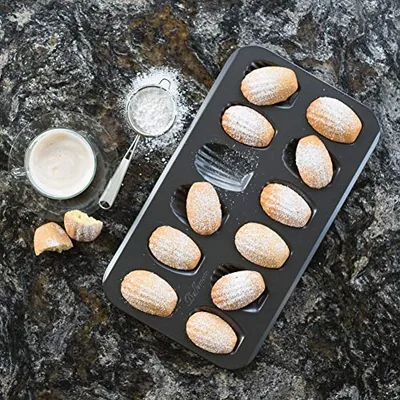
For a home baker, the carbon steel pan earns its place in a drawer. A donut pan has a ring of small wells. A madeleine pan has a row of shells. Both shapes depend on a clean turnout, because a stuck cake tears right at the curve. The coating asks for a careful hand and a soft sponge, and it gives back a clean release. It also keeps the surface smooth, so a quick rinse and a wipe are enough. We settle on that balance because the shape of a madeleine leaves no room for a stuck cake.
Aluminum and the moka pot
We use aluminum in one place only: our moka pots. Stainless steel is a poor conductor for a stovetop espresso maker. It warms too slowly, and the pressure inside builds in fits and starts. Aluminum heats fast and spreads the warmth across the base evenly. That steady push of steam through the coffee is what gives a moka pot its clean, full body. Steel would leave the grounds half-exhausted and the cup thin.
We make them in 3 sizes: 3, 6 and 9 cups. The threading and gasket seat follow the classic Italian design that has been at work since the 1930s. The 3-cup pot yields about four ounces, enough for one small strong coffee. The 6-cup is a morning pot for two. The 9-cup handles a round for three or four. All three have a cool-touch handle and a safety valve that vents if the boiler over-pressurizes.
| Piece | Size | Body | Price |
|---|---|---|---|
| Stovetop Espresso Maker, 6-Cup Moka Pot, Silver | 6 espresso cups | Aluminum | $20.99 |
| Stovetop Espresso Maker, 3-Cup Moka Pot, Silver | 3 espresso cups | Aluminum | $17.99 |
| Stovetop Espresso Maker, 6-Cup Moka Pot, White | 6 espresso cups | Aluminum | $20.99 |
| Stovetop Espresso Maker, 9-Cup Moka Pot, White | 9 espresso cups | Aluminum | $22.99 |
| Stovetop Espresso Maker, 3-Cup Moka Pot, Black | 3 espresso cups | Aluminum | $18.99 |
| French Press Coffee Maker Extra Filters Included, 35 oz | 35 oz | Stainless steel | $29.99 |
Aluminum will not stay bright the way stainless steel does. After a few brews the inner walls dull and a chalky white-gray patina spreads across the metal. That is the pot settling into its natural state. It does not affect the taste. Wash it by hand with warm water, mild soap, and a soft sponge.
Dry it immediately. Do not put it in the dishwasher, and do not reach for scouring powder or steel wool. A gentle patina protects the aluminum from pitting and staining. The pot gets better with use. It is the only aluminum tool we make, and we make it because no other metal does the same job as well.
Scouring pads, bleach and the things that scratch
Stainless steel is tough, but it scratches. The worst offender is steel wool. Even a quick pass leaves fine lines that dull the surface over time. We don’t recommend scouring pads with heavy abrasives either. They can strip the mirror finish from our bowls and colanders. A soft sponge and a little dish soap get stuck-on food off. If something is baked on, soak it first. The grain of the steel isn’t a coating, so you can’t scrub it off, but you can make it look tired.
Bleach is another thing to keep away from our stainless steel. It doesn’t hurt the metal right away, but a soak in a bleach solution or a spray cleaner with bleach can cause pitting, tiny speckles of corrosion that won’t wipe off. We’ve already talked about pitting from salt, and bleach works the same way. Dish soap and hot water are safer and they do the job. If you need to sanitize, use a food-safe sanitizer, not bleach.
Don’t use cleaners for silver or brass. They often have compounds that discolor the steel. Avoid oven cleaners and anything with a strong acid, like lime scale removers. A plain stainless steel cleaner is fine for a shine, but it’s not necessary. Most of the time, a damp cloth and a dry towel are all you need.
Our pieces have a fine finish, but they are not coated. They will pick up character over time, and the small scratches become part of the look. If you want a piece that stays mirror-perfect, stainless steel might not be for you. We think a little use is what makes it yours.
What to look for before you buy
A photograph can show you the shine. It cannot show you the balance. Bellemain means beautiful hands. We start from the hand. Before a tool is drawn, we think about the grip and where your palm meets the metal. We test every piece with real food. A ricer through potatoes, a sifter full of flour, because it has to feel right before it looks right.
Before you buy, pick up a tool you already own and ask whether the weight works for you. If a colander strains your wrist full, a larger one will only be worse. Heavy isn't always better. A cast iron press does a great smash burger, but a lighter steel one saves your wrist when flipping a dozen patties. Listen for the ring. A thick rim gives a dampened, quiet sound. A tinny ring points to thinner steel.
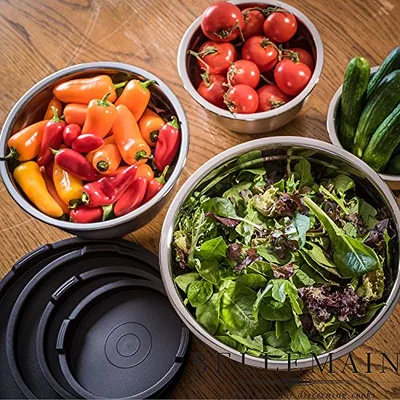
A tool that does not fit your kitchen is a tool you will resent. We publish the width and height of 44 of the 69 pieces in our catalog, because the real constraint is the drawer, not the counter. Most of our sets nest. Our largest, the 12-piece mixing bowl kit, collapses to fit a standard drawer. The bowls double as storage. The lids seal tight, so you can prep, mix, and store in one bowl.
Before you order, pull out the drawer you mean to use and measure its height. If a set says it nests to 6 inches and your drawer is 5, you will be happier with a smaller set. On 14 of our stainless pieces, the steel type is etched right on the metal. A missing stamp is something to notice from any maker. 15 of our tools are rated dishwasher safe. If you know you will never hand-wash a colander, stick with those.
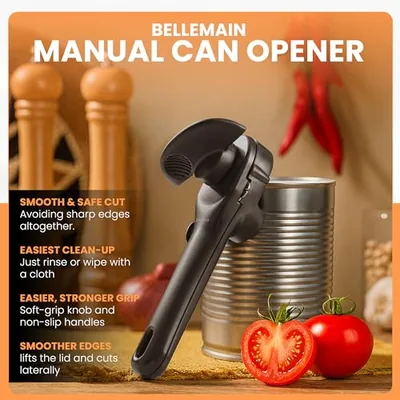
Finally, be honest about what you cook. Prices go from $3.00 to $77.98 for a reason. No one needs every piece. Our hand tools department covers 22 items, from can openers to meat pounders. A ravioli press is clever, but if fresh pasta happens once a year, it will live at the back of a drawer. If you are outfitting a new kitchen, start with the few tools you reach for every evening. Let the rest follow over time. That way the drawer stays useful, not just full.
Sources we read for this piece
- USDA Food Safety and Inspection Service, Cutting Boards, www.fsis.usda.gov/food-safety/safe-food-handling-and-preparation/food-safety-basics/cutting-boards. Read 23 August 2026.
- Centers for Disease Control and Prevention, Preventing Food Poisoning, www.cdc.gov/food-safety/prevention/index.html. Read 23 August 2026.
- U.S. Food and Drug Administration, Safe Food Handling, www.fda.gov/food/buy-store-serve-safe-food/safe-food-handling. Read 23 August 2026.